

Solutions
Logistics AI Systems
Netsam builds operational AI for freight, warehousing and dispatch: a study of how the operation actually runs, applications that replace manual and legacy steps, and AI agents that plan and optimize while dispatchers keep approval authority.

- Application modules plus a driver app
- 5
- AI agents
- 4
- Minimum shadow period
- 6 wk
- Delivery phases
- 5
The challenge
- A legacy component with no API sits in the middle of a daily-critical workflow and nobody wants to touch it.
- Planning quality depends on which experienced dispatcher is on shift.
- There is no live view of where the fleet is, and no defensible record of what was delivered when.
- Leadership wants operational AI but cannot accept a system that acts without a person.
Our approach
We start with a discovery phase that has exit criteria: engineers shadow every shift, observe legacy components over several operating days and confirm every integration before the architecture is final. The applications and live tracking come first, before any AI. Each agent is then introduced in shadow mode, where its plan is scored against the dispatcher’s plan every day and only the human plan executes, until published readiness criteria have held for six consecutive weeks.
What’s included
Operations Discovery & Systems Study
Structured observation of the operation: shadowing shifts, documenting legacy behavior and resolving integration unknowns, so the plan rests on confirmed facts.
Operational Application Suite
Receipt, Pick, Search, Proof of Delivery and Tracking, and Dispatch modules, plus a driver progressive web app that runs on personal phones.
AI Agent Layer
Load planning, route optimization, driver communication and daily reporting agents. Each recommendation carries a written rationale and a confidence score.
Shadowing & Readiness
AI runs in parallel with live human decisions. Both are recorded and scored, and only the human plan executes until measured readiness criteria are met.
Phased Delivery & Cutover
A five-phase program with a parallel run against the legacy system and a rehearsed rollback before any cutover.

Built for the people doing the work
Warehouse and dispatch staff work from the same live data on the devices they already carry. The AI proposes a plan with its reasoning, and a person approves it.
The driver app
A browser-based app on the driver’s own phone walks each stop through Arrive, Unload, Capture and Complete, recording times and proof-of-delivery photos along the way.
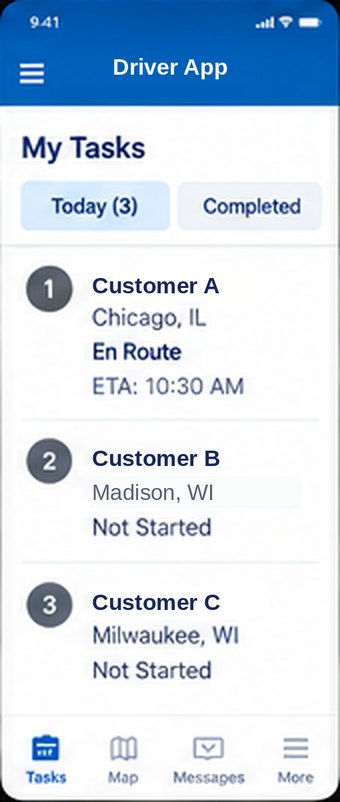
My Tasks
The day’s stops in order, with status and ETA.
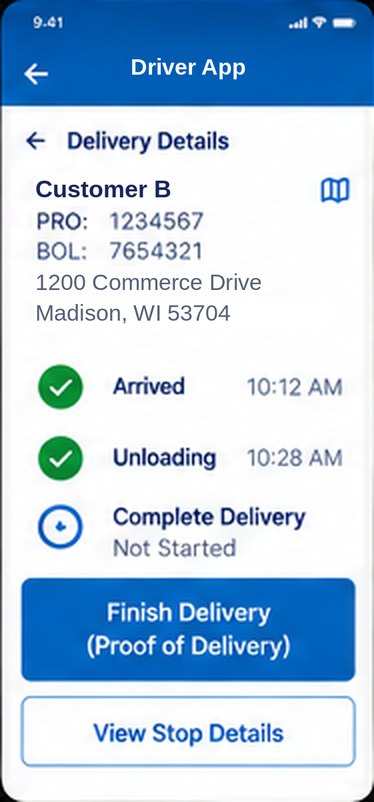
Finish Delivery
Arrival and unloading times are recorded as the driver taps each step.
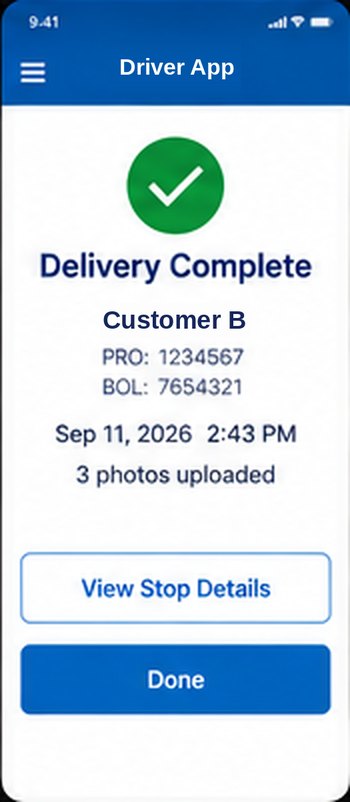
Delivery Complete
Proof of delivery with photos, confirmed and timestamped.
Why Netsam
- Discovery is a phase with exit criteria, not a kickoff call. Every resolved question is traced to the design decision it changed.
- A data abstraction layer isolates the new system from third-party database schemas, so you are not permanently tied to a vendor’s data design.
- AI does not touch live operations until it has matched or beaten the human baseline against published criteria for a sustained period.
- Override is available at every confidence level. The person accountable for the outcome can always countermand the system.
The AI does not touch live operations until your own comparison data says it should, and you set the threshold.
The five-phase rollout
Step 1: Setup
Environments up, unknowns resolved.
- Every integration confirmed and tested
- Device policy drafted
Step 2: MVP build
Dispatch and live tracking, end to end.
- Build a trip, assign a driver, watch it live
- Internal driver pilot
Step 3: AI agents
Agents live in staging behind approval.
- Load planning and route optimization
- Communication and daily reporting
Step 4: Hardening
Production-ready, users trained.
- Load test at twice peak
- Failure-mode runbooks drilled
Step 5: Parallel run & cutover
Validate against the legacy system, then switch.
- Variance below threshold for five operating days
- Rollback rehearsed
Technology
- React and TypeScript
- Progressive web app
- Node.js services
- PostgreSQL
- Claude API
- Mapping and routing platform
FAQ
Logistics AI Systems: common questions
No. Agents write proposals, not records. Dispatchers batch-approve the morning plan and approve each mid-day change. Override is available at every confidence level.